
Burning History
Egypt's Coptic Heritage in Peril
By Eva Dadrian
The recent destruction of more than forty Coptic churches across Egypt highlights the need to document and preserve these historic monuments.
In the course of its long history, Egypt has handed down to mankind a unique legacy of civilization, monuments and artefacts. Despite centuries of destruction – either at the hands of man or by the traditional causes of decay – these monuments have survived as witness to artistic and cultural splendor, majesty and ingenuity, qualities that continue to astonish millions around the world. Today, however, these same monuments and artefacts are subject to an even bigger and more dangerous phenomenon than slow neglect or erosion: the systematic zeal to annihilate all that reflects Egypt’s national past.
Egyptians have always been proud of the historic legacy bestowed on them by their forefathers. The beginning of the last century saw extensive archaeological finds that attracted worldwide interest and spawned Egyptomania. Furthermore, it prompted a deep-rooted feeling among Egyptians that the ancient monuments of their long history have to be preserved not only as treasures, but also as big business. Indeed, Egypt’s national heritage has shaped the country as we know it today. It is part of the DNA of every single Egyptian; therefore, whenever someone sets off to destroy that heritage, they are in fact destroying the very fabric of the nation.
Since the 25 January revolution, safeguarding and preserving Egypt’s Pharaonic, Christian and Islamic heritage has become one of the most pressing issues for both heritage activists and the Egyptian authorities. It assumed an even greater urgency when, in August 2013, more than forty churches were burned and looted in a wave of attacks across the country. According to many, these latest attacks – said to be in retaliation against Christians for supporting the ouster of President Morsi – were the worst in centuries. Whatever the reason may have been, however, I cannot help but ask, ‘why destroy something that belongs to all?’
Preserving and safeguarding Egypt’s Christian cultural heritage cannot be achieved unless it is recorded and registered. Together with the editorial team of RAWI, the author of this article spent almost three months searching for historic data about the churches destroyed last August. Despite the numerous and valuable books published on Coptic churches, however, very little, if any, information about these churches’ origins are to be found in their pages. No one knows the reason behind this lack of data, but Father Wissa Sobhi, of the bishopric of Deir Mawas, explains that the Coptic Orthodox Church has been more concerned with ‘preserving the souls of its flock than preserving brick and mortar’.
For Father Maximus al-Antony, this widespread attitude may not be the only reason. A monk from the Monastery of Saint Anthony in the Red Sea Mountains, Father Maximus – considered by many to be one of the church’s top conservation and heritage experts –believes that Coptic heritage is disappearing ‘because of random restoration work, urbanization and the work of the ignorant’. What is more crucial for the heritage expert is the shortage of proper documentation, as Father Maximus emphasized in a recent interview, ‘I don’t want future generations to curse us for not documenting what we have now’.
The need for proper documentation is all the more pressing because many old churches have already been lost. The Coptic Encyclopaedia reminds us that monasteries and churches built during the early centuries of Christianity in Egypt were made of mud-brick and hence vulnerable to erosion. Al-Maqrizi, the fifteenth-century Arab historian, says that most churches in Upper Egypt were demolished and replaced by mosques. This knowledge makes the events of last August even more heartbreaking. During the recent wave of attacks, in the governorate of Minya alone, eighteen churches were vandalised and destroyed. Before being set on fire many of these churches were looted, their sacred objects stolen, including precious icons dating back to the sixteenth and seventeenth centuries.
What can we say about the history of these churches and their recent fates?
Certainly, some were very old. Visiting many of the primarily Coptic populated parts of Upper Egypt, al-Maqrizi mentions several monasteries and churches in and around Sohag, Akhmin, Qena, Assiut and Minya. Based on al-Maqrizi’s visits and descriptions, one is inclined to think that the churches and religious monuments destroyed in Minya, Beni Sueif, Sohag and Assiut last August may have been built centuries ago. On the other hand, as certain monuments are not mentioned by either al-Maqrizi or Abu Salih al-Armani (thirteenth century), they may well have been built much later.
Amongst the churches attacked is the 1,600-year-old Church of the Virgin Mary and Father Abram in Deir Mawas, sixty kilometers south of Minya. It stands today gutted by fire and stripped bare of its contents, its ancient naïf iconographic murals depicting the Virgin Mary lost forever. All that remains of this unique national treasure are its late-antique stone walls.
Similarly, in the village of Delga, sixteen kilometres west of Deir Mawas, the church dedicated to the Holy Virgin (al-‘Adra), which stood in the middle of the village, was burnt. Massimo Capuani, an expert in Coptic art and architecture, writes that over the course of centuries the interior of the church was remodeled, but that a few columns dating from the early years of Christianity had been kept, proving the church’s antiquity. Describing the church, Massimo says that at the ancient entrance was a ‘bas-relief representing a cross with two gazelles’. This is now a pile of rubble.
Al-Amir Tadros Church (Tawadros), though located behind the Minya Security Directorate, is another casualty. Built some 110 years ago, al-Amir Tadros, now stands gutted and in ruins. An eyewitness recalls how a mob ransacked the church, throwing molotov cocktails and gas canisters, before taking away precious sacred objects and setting fire to the building. The wooden painted ciboria – the vaulted canopy placed over the altar – and the church’s magnificent iconographic wall paintings were burnt to ashes.
When the news of the looting at the Mallawi Museum and the destruction of the religious monuments in Upper Egypt reached her desk, Irina Bokova, UNESCO director-general, expressed her grave concerns for Egypt’s cultural heritage. Promises have been made for the reparation of the churches, but with all the goodwill in the world nothing can replace the centuries-old wall murals, icons, porcelain sculptures, wooden statues and reliquaries that have been turned to ashes. The attacks perpetrated last August against the Coptic churches are a dire illustration of the danger facing Egypt’s national heritage. What do the Egyptian authorities need to do to stop the destruction of the national heritage? Do they have to rush to find some magical legislative solution? Let us remember that laws cannot protect a society that has lost its ethics.
Photography by Nasser Sobhy
This article was first published in print in RAWI's ISSUE 6, 2014
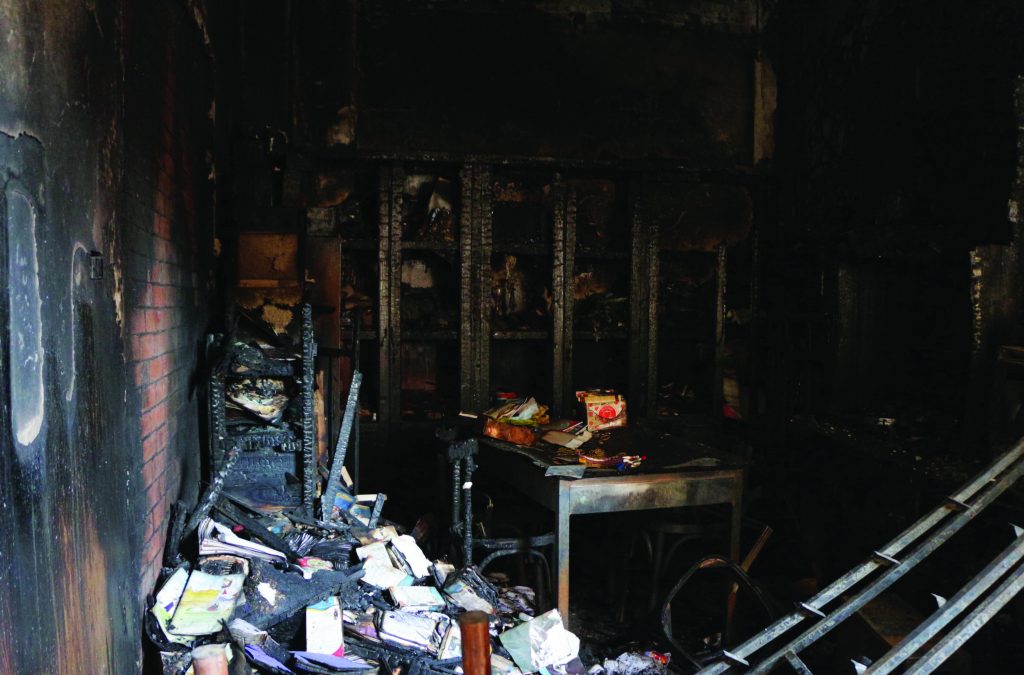
Ransacked interior of Saint George’s in Sohag. Built at the beginning of the last century, Saint George’s was the seat of the Bishopric of Sohag. The majority of the population in the governorate of Sohag is Christian. The governorate is home to numerous churches and is known worldwide for the White Monastery and the Red Monastery. NASSER SOBHY
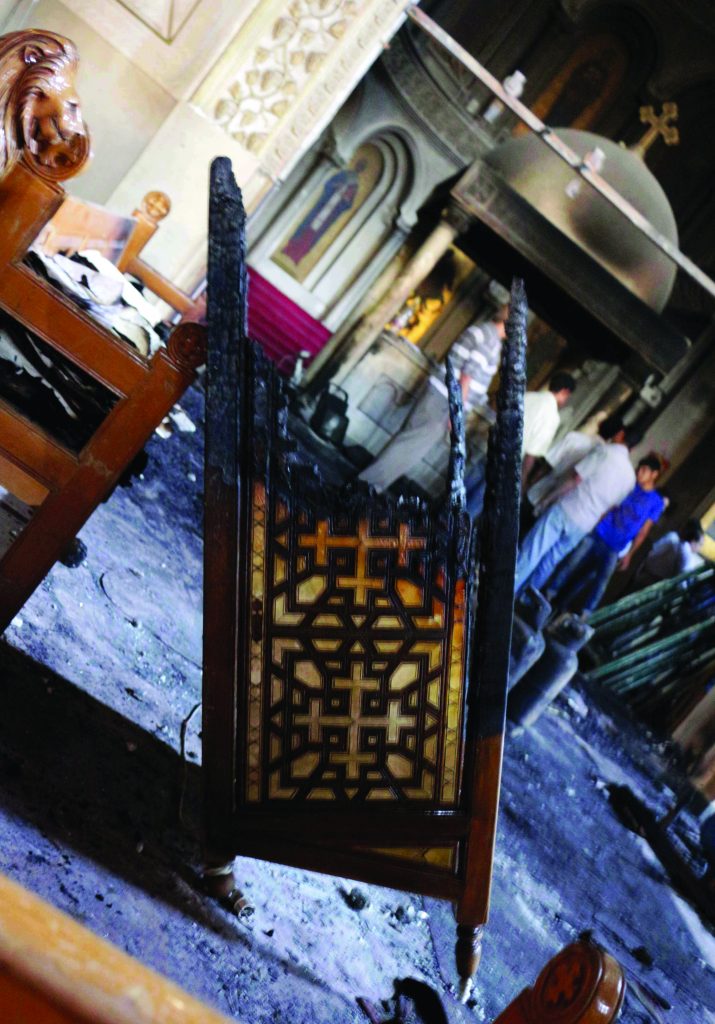
Burnt wooden ciboria and pews at Saint George’s in Sohag. NASSER SOBHY

Eva Dadrian
Eva Dadrian (1944-2018) is an Emmy Award-winning British-Egyptian independent broadcaster and writer with extensive experience in Africa, the Middle East and Europe. Dadrian worked as a political risk analyst for Arab Africa Affairs (London/ Cape Town). She also wrote for al-Ahram Weekly and al-Ahram Hebdo (Cairo) covering issues ranging from art and science to environment and religion for the BBC World Service.