
The Most Beautiful of all Wounds
The World of Traditional Egyptian Tattoos
By Emmanuelle Perrin
Issue 6
نسمة جبر
Much more than simple body adornments, traditional Egyptian tattoos incorporate complex meanings and evoke tales of knights, seductresses and animals in a multicolour world of the imagination.
Thanks to the collections of tattoo artists, painted on glass and preserved since the 1930s at the Museum of the Geographical Society (Cairo) and at the Museum of Branly Quai (Paris), we can draw up an inventory of Egyptian tattoos: geometric shapes both ornamental and medical, religious themes, symbolic bestiaries, figures of men and women, and be struck by the greatly evocative force of such symbols – always with multiple meanings, always ambivalent. This multicoloured world of birds, fish, lions, snakes, crosses and mosques, epic knights, women brandishing sabers or garlands of flowers, opens itself up to the imagination and collective representations. Multiple sources, meanwhile, lend themselves to the analysis and understanding of these images: miniatures and chromolithographs, bestiaries and cosmogonies, fables and proverbs, literary motifs, legends of saints, knowledge of magic and divination, religious beliefs.
Geometric motifs: jewelry and amulets
The famous work of Edward Lane, for example, features a woman tattooed between her breasts, down the length of an arm, above the eyebrows, the chin and the hands. The ornamental and erotic nature of these tattoos seems at once apparent. Many authors have put equal emphasis on the use of “medical tattoos” for treating headaches, bone and joint lesions, skin diseases, stomach ailments, and toothaches or inflammation. Geometric tattoos also have protective virtues. We find this with W. Blackman mentioning a tattoo protecting children from the qarina (i. e. compagnon) of their mother. This evil spirit, similar to doppelganger (each human being has such a « double », threatens to abduct the children of her human « sister ».
Each human being has a « double »
Religious motifs
Among Christian motifs, we find figures of Christ as well as representations of St. George and St. Michael. The equal-armed cross, often adorned with fleurons or T-shaped « potencées » (a heraldic shape –similar to a cross) , is one of the most numerous and varied motifs. Copts frequently tattoo themselves, often from childhood, a cross on the wrist or between the thumb and forefinger, a ritual in practice since the eighth century, giving the bearer assurance of being buried in consecrated ground or acting as proof of his faith in the Day of Judgment. Besides the crescent so often present in these geometric and floral compositions, they also figure mosques and dromedaries (camels) driving a caravan of pilgrims from Mecca. These Muslim motifs could therefore attest to a pilgrimage to Mecca, to Medina, or to the grave of a saint.
Bestiary/Animals
The bird of thought
Under the name of “bird of thought” (aṣfûr el-fikr), this motif is tattooed between the eye and the temple as a remedy for headaches and “weakness of spirit.” Various proverbs associate the bird, the head, and thought: “As if a bird was perched on the head” suggests, for example, the immobility of people absorbed in their thoughts. “The birds made his head fly,” on the other hand, signifies a fit of anger. However, the expression “he was tattooed in birds” is used to describe someone of great stupidity. This is in reference to the conflict between farmers and city dwellers, as in the saying: "You may civilize the farmer, but his tattoo never disappears."
The fish: fertile and nourishing
The fish appears as a symbol of fertility, a symbol that is also has associations with Christ for the Copts. It is also curative and protective since it exists in pisciform [fish-shaped] amulets. Could it also figure in a trade emblem? That practice of fishing is in effect regular in Egypt, from which perhaps stems the nourishing character of this symbol. In the image of a siren incorporates a female aspect to the motif, evident in the symbol of the bust of a woman coming out of the mouth of a fish.
Lion combatant, lion tamed
Lions often appear armed or lined on each side by a palm tree. The motif of the lion trampling a snake – the fight between a solar animal and a chthonic animal – could symbolise the victory of good over evil. An ambivalent figure, the lion represents the qualities of bravery, magnanimity and strength as well as savagery and ferocity. Here, one may need to examine the meaning of tattoos featuring lions that have been tamed, chained to a palm tree, held by a leash by an armed woman, or mounted by a man. The animal also represents the attributes of holy persons: Ali, son-in-law of the prophet, and “lion of God” St. Mark, who evangalised Egypt. Numerous saints transform into the form lion of a lion, or they overlap with them, which demonstrates their mastery of nature and of desire.
The snake: fear and power
Beyond its well-known phallic undertones, the symbolism of the serpent is particularly complex. In the interpretation of dreams, as in proverbs, it appears essentially as an enemy and evildoer. Proverbs introduce other images, however: “If a snake comes to love you, wrap it around your neck,” “Near to a scorpion, venture not, but near to a snake, make your bed and sleep.” According to Jâhiz, along with the crab and the fish, the snake figures among the most respectable of God’s creations; it was said to be blessed with an extraordinary longevity and prodigious strength. Does this considerable power inspire these tattoos, or does it have the capacity to dominate them?
The rooster: a clear-eyed, masculine animal
The rooster is well known for its virility. It is thus said that a man who is courageous, proud, and dominant has “become a rooster.” It is a sun symbol, since its song announces the birth of the day, from which stems the reputation of its “clear eyed” nature. It is equally tied to the celestial world: its benign song would be triggered by the vision of an angel, in contrast to the braying of a donkey, which is caused by a demon. In creation myths, roosters echo the song of an enormous angelic rooster in paradise under the throne of God, announcing hours of prayer.
The goat: nurturing and submissive
Analogies with leonine [lion-like] motifs suggest that the goat form, as a symbol of the sun like the lion and the rooster, is a "force" that can be tamed by chaining it to a palm tree under the banner of Islam. It is also a symbol of nurturing through its milk, hair, and leather. It evokes in equal measure its vitality alongside its capriciousness and unpredictability. The animal climbs along the tops of mountains and in Christian symbols often associated with strong vision. Given its status as a more common type of livestock compared to camels, whose breeding is more prestigious, the goat may symbolise moderation and modesty. Finally, it is seen as shameless, since, unlike sheep, the goat’s tail does not cover its rear.
Male characters: figures loved, rebellious, and virile
Among the male figures listed, various motifs may appear, such as tattoos of trade or profession, such as: donkey driver, a juice or licorice syrup seller, a policeman. These motifs may represent the beloved, whether or not identified by his profession. Acrobats figure equally among these drawings. Perhaps this professional emblem also represents a reversal of values. In another form of challenge to the established order, we see a representation of a fight between a man and a policeman. The tattoo was often associated with criminality. Alexandre Lacassagne (1843-1924), a doctor from Lyon, in his work in psychology and criminal anthropology was deeply interested in the subject of prison tattoos. One Mr. Caloyanni, meanwhile, counselor to Cairo’s High Court, proposed a “study of the tattoos of Egypt’s criminals,” in which he considered this practice to be the stigmata of delinquency and prostitution. “Indeed, every tattooed man, [...] is a criminal addicted to hashish, opium and their derivatives. Women with these signs are prostitutes, and juveniles, mostly early inverted. "
The motif of the knight, on horseback or on a lion, is the most common male figure. This armoured knight sports an immense mustache and winged helmet sometimes topped with a crescent. This may be identified as Antar ibn Shadâd, sublime hero of the sîrat ʿAntar, model of knighthood from Arab novels. He represents masculine virtues: virility, bravery, generosity, loyalty, and protection of the weak. “Image of all that a man can become,”the knight symbolises mastery – mastery of his mount, even if a lion, and of the cause that he serves.
Female characters: figures of desire, and the woman of two faces
Very widely represented as figures of desire and seduction, women are seen dressed in their finery. They have, as a sensual provocation, unfurled hair and often wear plentiful and heavy jewelry. A first series of motifs evokes the `arûsa, the doll, the fiancée, the young bride; women as birds, women as flowers. Other drawings form motifs of union and fertility: couples walking and shaking hands, with a woman's bust in the centre or a floral decoration, her hand holding a bouquet. They also feature a mother carrying a child in her arms or with him riding on her shoulders.
The image of the seductress asserts itself with the poetic and gallant motif of a woman with a jar. There is also an entire series of women given masculine attributes: women with hookahs, women with rifles or brandishing sabers. Featuring equally are courtesans, naked and dancing. The armed women, and even moreso those who hold chained lions, evoke images of Amazons and mortal seduction. Caloyanni asks, among the tattoos worn by women, do the female figures – doll or Amazon – show how they identify themselves?
***
The repertoire of motifs in Egyptian tattoos allows us to examine the main intentions of this practice, with their often painful and indelible character being key. The tattoo is both jewelry and amulet, therapy and protector. It is a heraldic sign of recognition and distinction, of allegiance and fidelity. These collective representations are at once fragments of autobiography, trials overcome, varied virtues, sworn loves, and the most beautiful of all wounds.
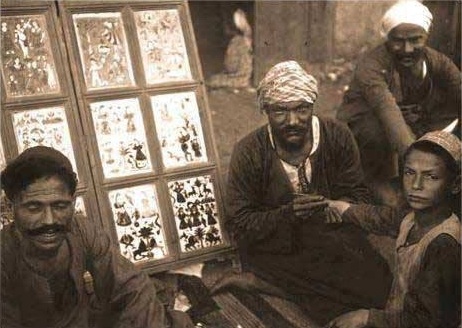
A tattooist with a customer, circa 1930. Photo courtesy of the Austrian National Library Archive
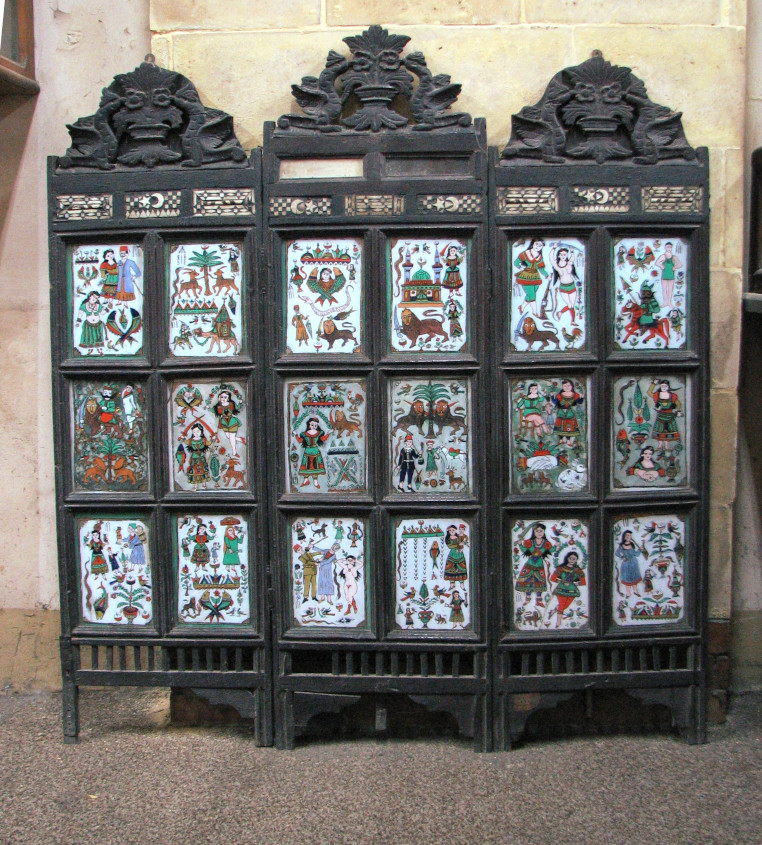
A tattoo board at the Egyptian Ethnographic Museum. Photo Yasmine El Dorghamy
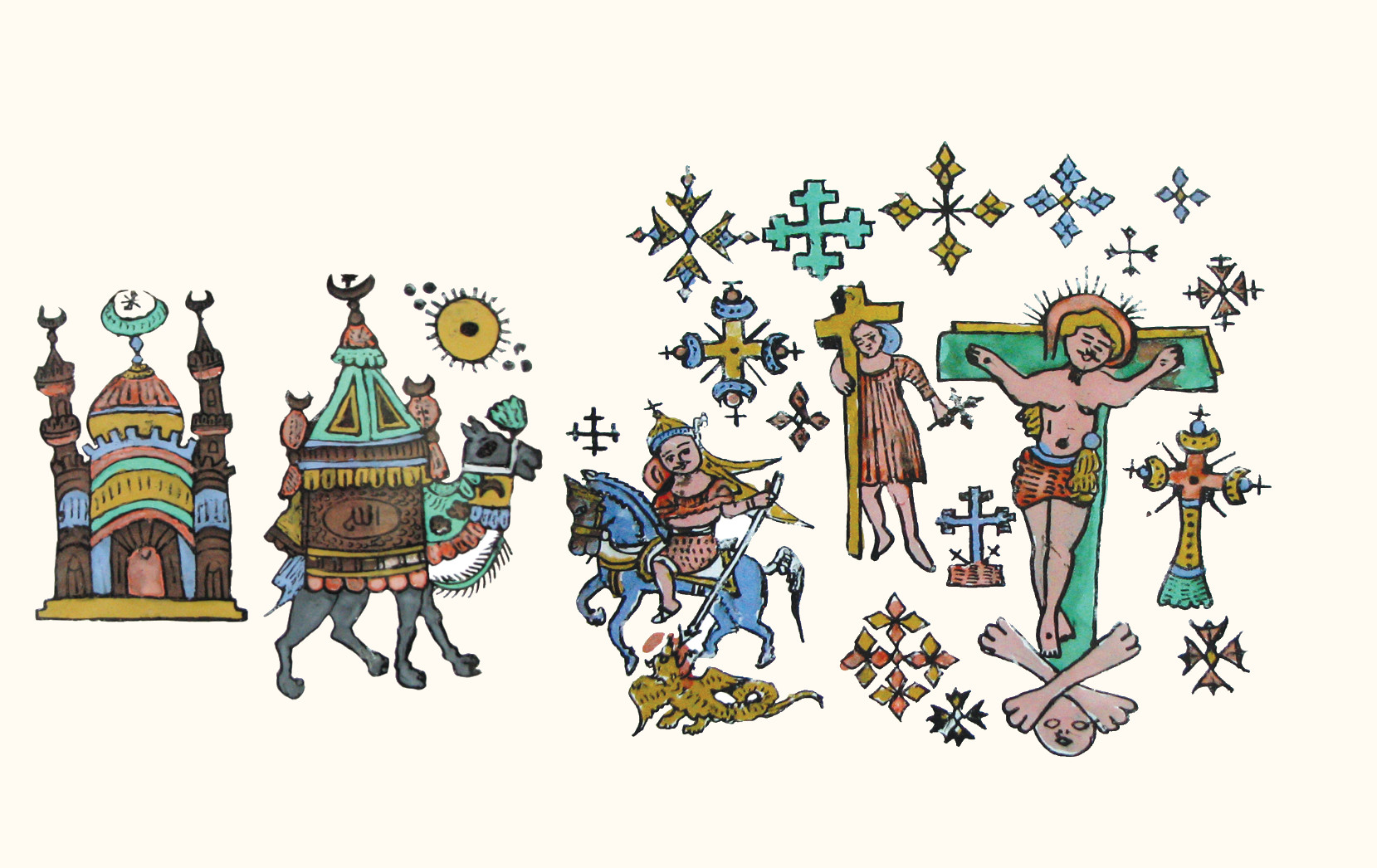
Religious Motifs
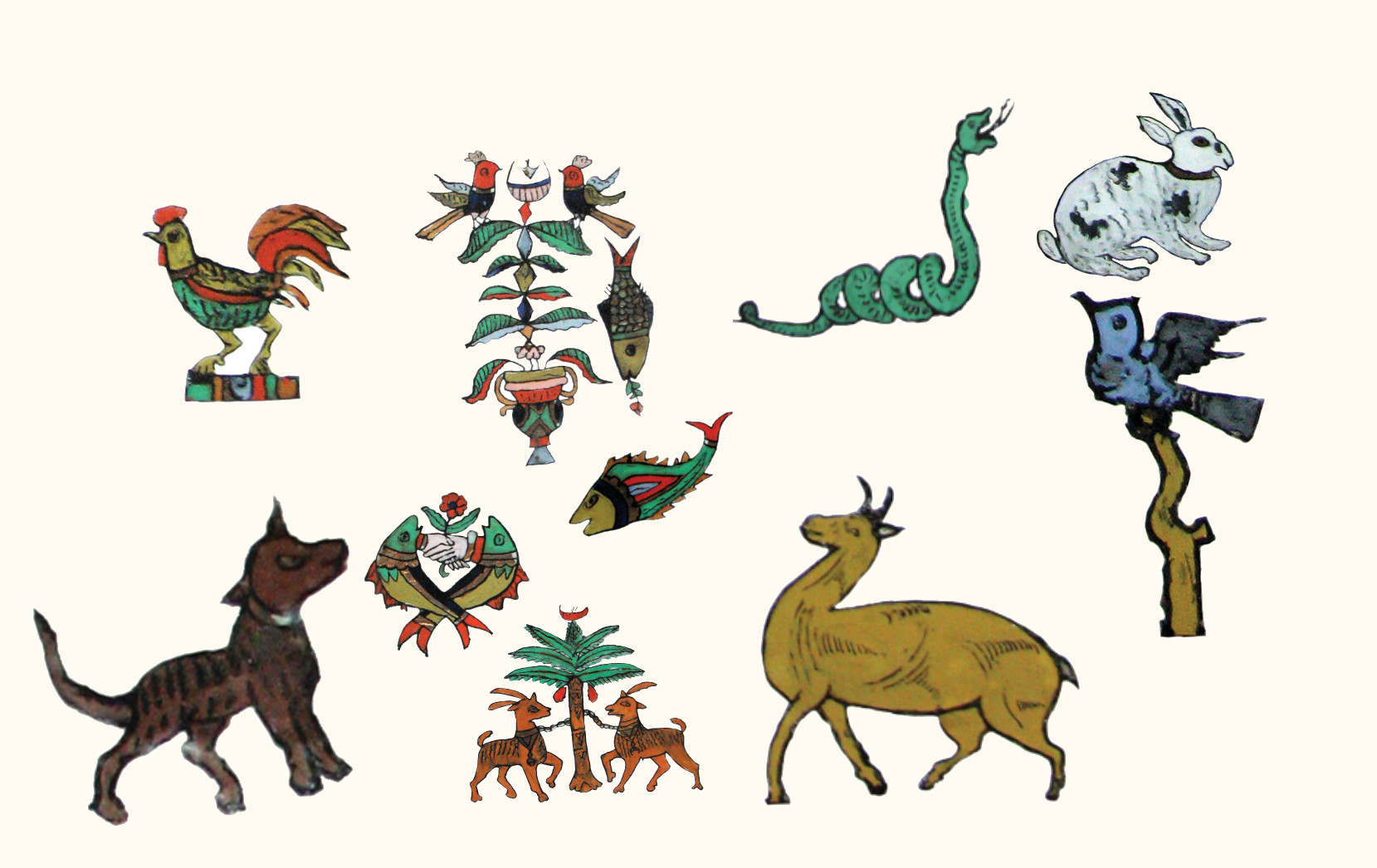
Bestiary/Animals
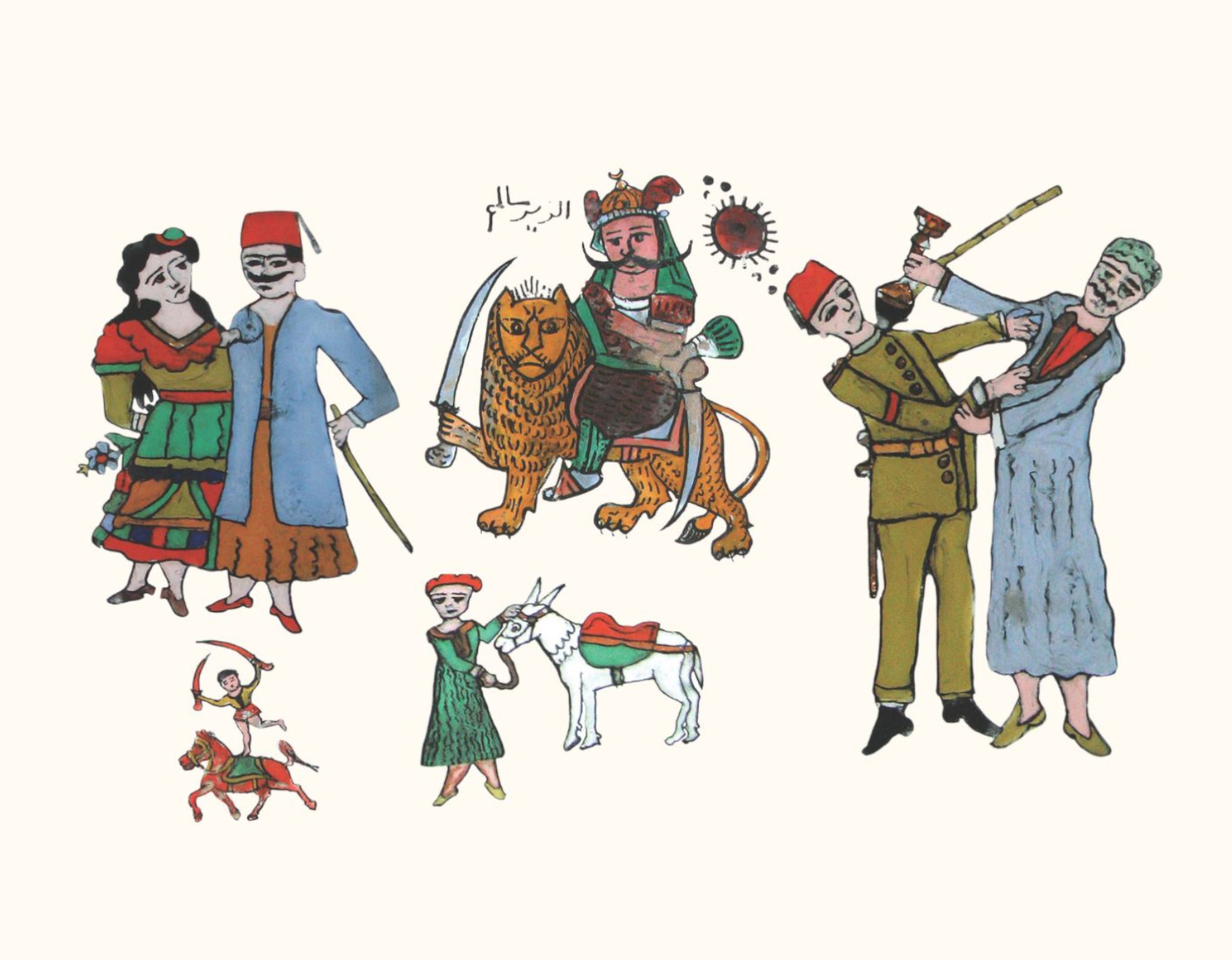
Male characters: figures loved, rebellious, and virile
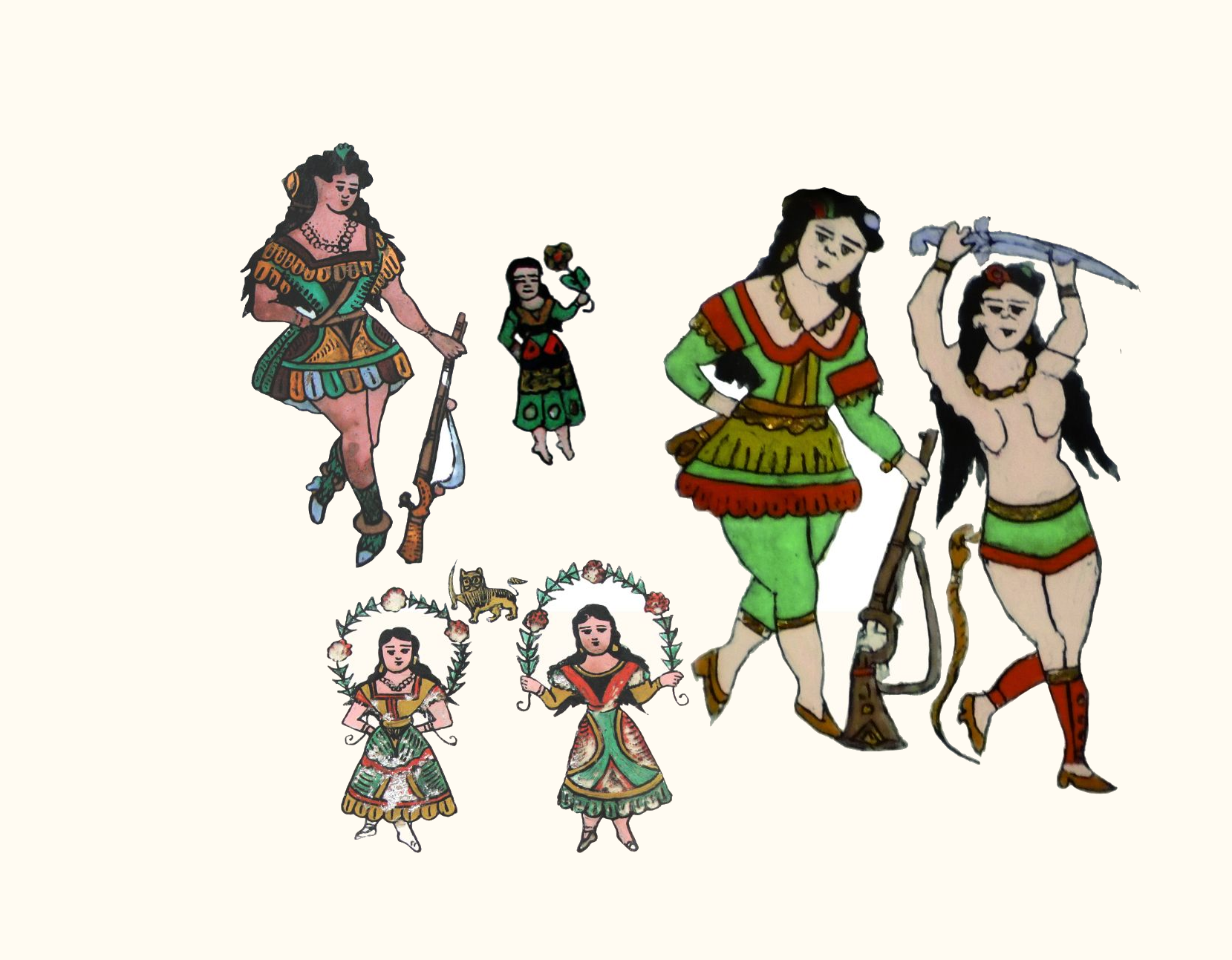
Female characters: figures of desire, and the woman of two faces

Emmanuelle Perrin
Emmanuelle Perrin is a historian of the ethnography of Egypt. Her thesis studied the Dictionary of Egyptian Customs, Traditions and Phrases, published in 1953 by the scholar Ahmad Amîn and one of the first texts recording and describing Egyptian folklore. At present, she works at InVisu (USR 3103 CNRS/INHA) on the Romanization of Arabic geographical names.