
Dreamers and Rebels
The Artists of the Mid - Twentieth Century
By Youssef Limoud
Issue 8
Translation: Shereen Moussad
Fuelled by dreams of revolution and freedom, Egypt’s second and third generations of artists produced rich creative output unparalleled to this day.
A brief look at some of the artists of the time

1900
1970
The first generation of modern Egyptian artists was driven by the need to define the Egyptian identity through artistic expression. They feared that foreign cultures and influences would diminish and ultimately devour the Egyptian character. This concern was clearly portrayed in the works of the pioneers such as Ragheb Ayad, Mahmoud Saїd and Mahmoud Mokhtar at the dawn of the twentieth century and became more prominent in the works of the generations that followed them. Several art societies and groups were formed. The Contemporary Art Group, founded in 1946, was perhaps the most expressive of public spirit at the time. Through the works of artists like Hamed Nada, Maher Raef, Samir Rafi and Abdel Hadi el-Gazzar, the group adopted surrealism in principle and philosophy. At the same time, the concepts of revolution and rebellion took root with the intellectual elite of the period, particularly with the members of the Art and Liberty Group who preceded and influenced the Contemporary Art Group. While Art and Liberty were the pioneers in adopting surrealism as their doctrine, they were more exposed to Western thought and less concerned with the issue of national identity. They considered thought and art universal humanistic languages that should not affect the artist’s sense of belonging to the geographic location in which he was born and raised.
With the advent of the 1952 revolution, the Nasserist dream triggered a revival of the cultural spirit in Egypt. The generation of artists that appeared in the 1960s was determined and hardworking in all areas within the cultural framework, from cinema and theatre to literature and the fine arts. The Egyptian art scene was vibrant and cultural activity was not limited to the capital. In the mid-1960s, three young Alexandrian artists (Said al-Adawy, Mahmoud Abdallah and Mostafa Abdel Moatei) formed the Experimentalists Society when they were still at the newly established Faculty of Fine Arts. Full-time grants were available to artists, and residencies at Luxor’s al-Marssam gave them the opportunity to experience Upper Egypt and to delve into the historical layers that formed the basis for the symbols and traditions of their heritage. Hamed Nada was one of these artists. Nada’s discovery of Ancient Egyptian art during the period he spent in Luxor at the start of the 1950s had a profound influence on his work and he continued to develop these themes throughout his life.
An examination of artistic output in Egypt since the 1940s shows intellectual and artistic diversity, especially when measured against the general decline in Egyptian art from the 1980s onwards. There were many reasons for the decline but perhaps the most important one was the military defeat in June 1967, which damaged not only the essence of Egyptian existence but also that of the Arab world as a whole. The Islamic wave that followed, which in itself was a reaction to the June defeat, coupled with the negative effects of the economic openness of the Sadat era, upended Egyptian society: elevating people to the top of the social ladder who had the financial capacity but not the culture or taste to go with their new social standing. Over and above, a rift occurred among the intellectual elites: those in opposition to the peace treaty with Israel were side-lined and many untalented opportunists were put in positions of authority over those with real talent. Some emigrated, others took to seclusion. Some betrayed their principles, pandering to the tastes of the new bourgeoisie. By the 1980s, the bright flame of the 1960s generation had been all but extinguished giving way to the screams of self-doubt and aborted dreams. No art could thrive in a landscape dominated by an impossible mix of interference, opportunism and autocratic cultural rule incapable of little besides the tasteless activities of the official establishment.
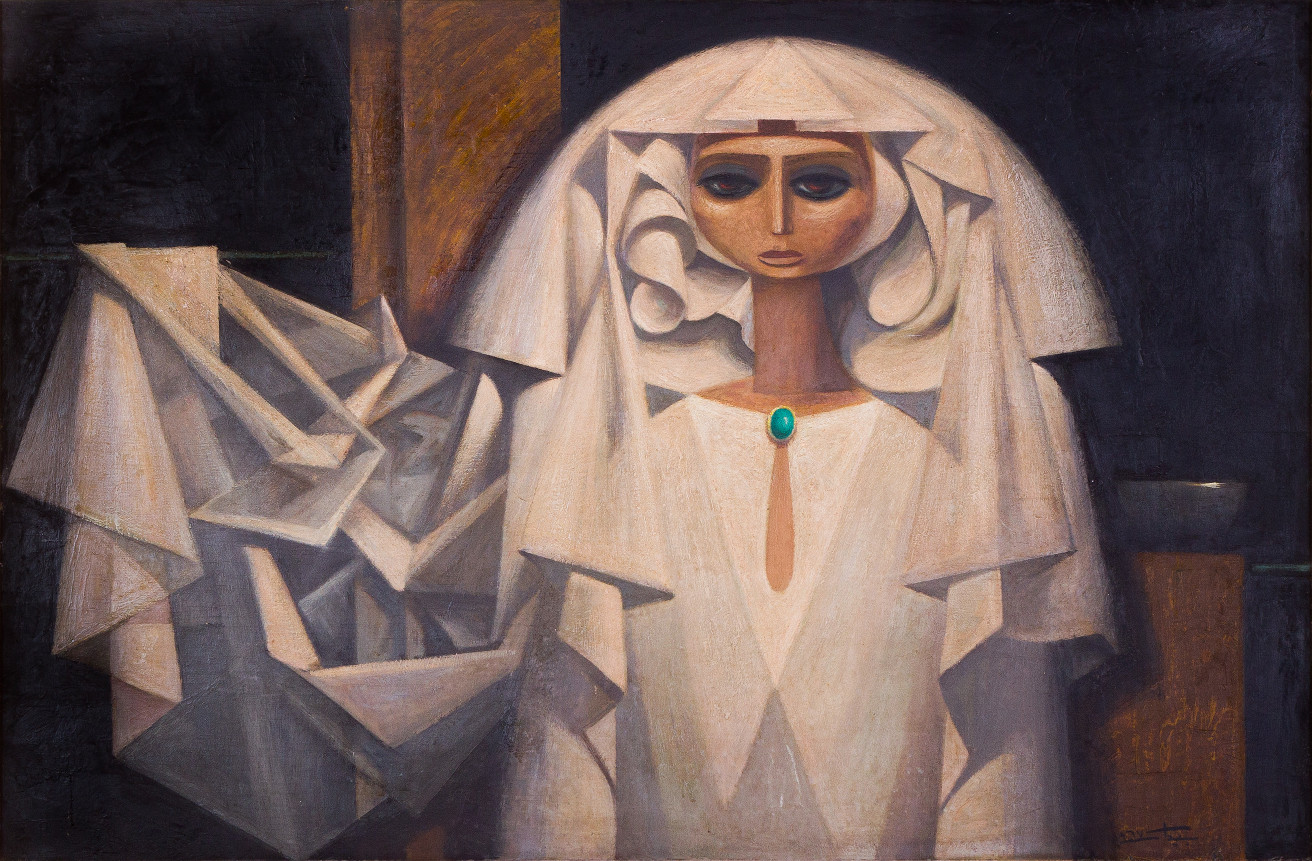
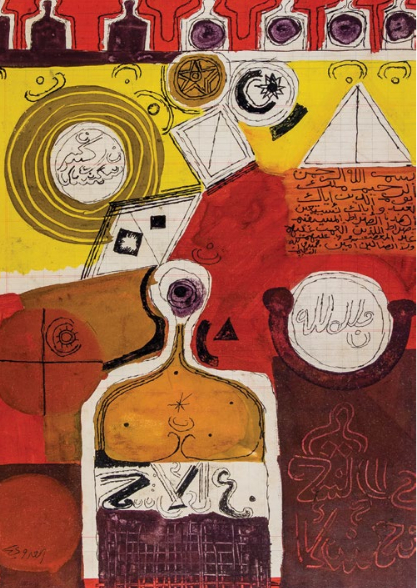
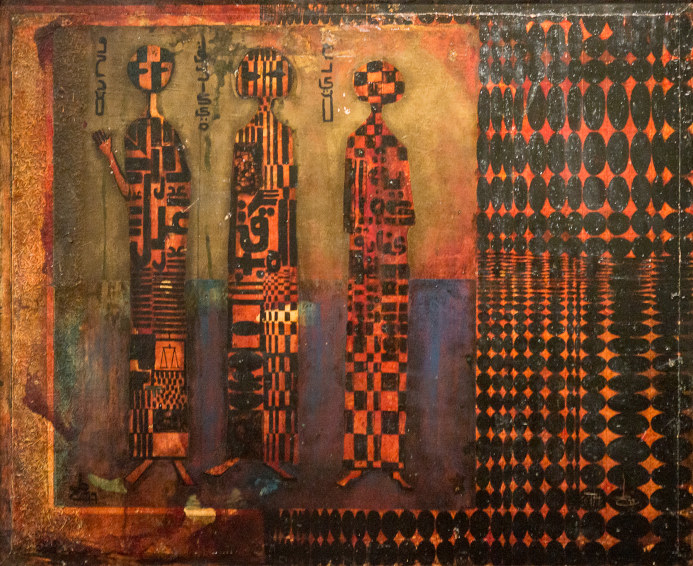
The artistic movement of the 1960s and 1970s certainly kept pace with international artistic trends of the times, even if it was, in most part, Egyptian in nature and reflective of the search for identity. This was expressed by different artists in different ways. Some, such as Effat Naghi, Saad al-Khadem, among others, searched in Egyptian folklore. Others, including Hamed Nada and Abdel Hadi el-Gazzar, delved into local legend and Pharaonic heritage while calligraphy and Arab heritage provided inspiration for the likes of Abu Khalil Lutfi and Salah Taher. They covered all kinds of topics ranging from the implicit or explicit expression of the inner complexities of the self to the political (Abdel Hadi el-Gazzar, Rateb Sediq) and the social (Gazbia Sirry, Mohamed Mostafa). This artistic momentum, with all its diversity in principles, schools and experimental practices in medium, technique and topic, demonstrates that the overarching aim of artists at the time, was the strong desire to find their own square on the international chessboard, not only in the arts but in all fields.
In spite of this frenzied artistic activity, the obsessive preoccupation with identity limited Egyptian artistic thought of that era to the horizons of home, finding inspiration solely in its heritage, symbols, folklore, decorative art and in defining the concept of ‘Egyptian-ness’. There is no doubt that it is necessary for the artist to dig deep into the accumulated layers that form his reality to be able to produce authentic work, but if the incentive of this excavation is solely to issue a figurative identity card that is of no concern to anyone save the artist himself, this reeks of fanaticism and close-mindedness. Likewise, adopting Western artistic movements and schools—without attempting to intellectually develop them—put Egyptian art in the position of passive recipient. The idea of embodying the concept of national identity, from the perspective of Western intellect, and using Western artistic techniques, is a contradiction which begs us to question the level of self-awareness of the time.
Let’s take a brief look at some of the artists of the time with their varying artistic directions and leanings:
Effat Naghi (1905–1994)
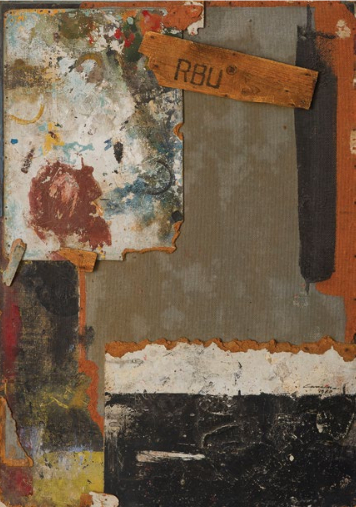
Naghi found in minimalism, which she took to the furthest reaches of reductionism, a plane field encompassing all the forms, symbols, signals and artistic elements she needed to reproduce her world. She could control the energy, inter-relation, symbolism and expression that stemmed from the presence of these elements side by side on the canvas, garnering their inner energy and calmly spreading it throughout the artwork. Naghi, along with Mounir Canaan, was a pioneer in destroying the conventional concept of a painting. Not for her the traditional rectangular or square frame—rather, her work area was an amalgam of protruding forms arranged in a way that made her painting no longer a painting, but rather an object or a wall-installation that effectively blurred the lines between artistic genres.
Mounir Canaan (1919–1999)
Canaan was an abstract artist who navigated the pathways of pure form, unburdened with personifications or other clutter demanded by audiences. The path itself and the attainment of non-form were his aims. According to Christine Roussillon, a French art critic with a master’s degree from the Sorbonne on Canaan, ‘obliterating’ form was his tool of choice to realize these aims.
Marguerite Nakhla (1908–1977)
The spiritual heritage of Christianity is present in the realistic works of this Alexandrian artist of Lebanese descent. Nakhla derives her inspiration not from a cultural perspective based on a religious upbringing from early childhood, but rather from an abundance of spirituality which makes the drawing of details an opportunity for contemplation or even an act of worship in and of itself. She frequently painted icons of biblical stories as well as church murals both in Egypt and abroad, but it is for her folkloric paintings that she is celebrated. The pulsing spirituality and deep understanding of the details of folkloric reality, crowded with humanity—whether in the marketplace, the communal baths, the bourse or at the church—made Nakhla’s secular paintings themselves akin to religious icons.
Hussein Bicar (1913–2002)
Bicar was highly regarded both as a visual journalist and as an illustrator of children’s books. He was also a solid academician and one of the most famous Egyptian portrait painters throughout a long and fruitful career spanning most of the twentieth century. He was a musician, playing the oud and harp and writing zajal (strophic poetry) to accompany his weekly contemplative illustrations published in the newspaper. It can truly be said that he elevated visual journalism to the level of artwork. However, the works which he intended to be purely expressive and ‘art for art’s sake’ were never free from illustrative, journalistic influence. This renders us incapable of viewing them purely as he intended. The ‘Bicarian’ experience, with its many achievements, unique lines and minimalist approach to form, allows us to say that his life itself was the real artwork.
Hamed Ewais (1919–2011)
It was inevitable that the Egyptian art movement would produce an artist like Hamed Ewais; both as a person and as a direction in art. Our concern here is the latter: his socialist realism, as a direction, a philosophy, a tendency and a human need, was necessary to complete the portfolio of the artistic movement, which in itself was an expression of society. This artistic tendency is a highly responsible one, adopting the cares and concerns of the people—from workers and peasants to soldiers and students—and other social, national and human topics including the celebration of victories and the defence of the Palestinian cause. Ewais portrayed world-dominating imperialism in the form of a metal monster, reflecting his sincere empathy with the underprivileged and the victims, and dreaming of a socialist reality where all are equal in the justice and the opportunities they receive in life.
Hamed Nada (1924–1990)
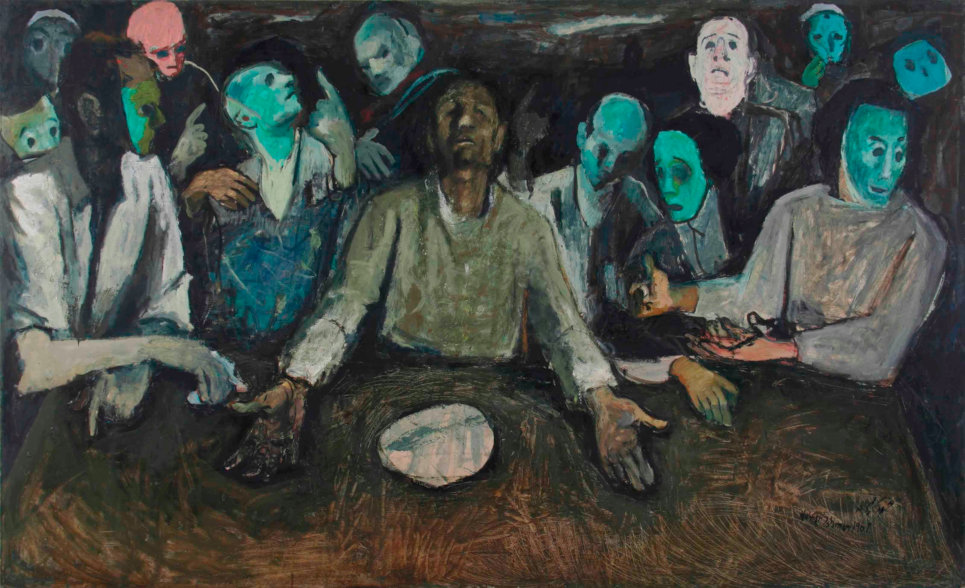
In the beginning, Nada’s art was very austere—almost ossified—in its surrealism. After discovering Ancient Egyptian art, however, he found in it his own artistic purpose, paradoxically imbuing an originally static heritage—mainly concerned with death and the afterlife—with a dynamic vivacity closer to the spirit of dance or music. He was fascinated by traditional ritualistic ceremonies and primitive totemic practices which his conscious and sub-conscious assimilated and intensified to conceive modified human forms and bodies reminiscent of cave drawings. He created his own version of surrealism. His works took artistic expression to depths far removed from surrealism as a concept, in as much as they adopted it as reality and existence and emotion: the musician becomes not only his instrument but becomes the music itself. Woman is the goddess Hathour, the gypsy, the core out of which all the dizzy shards from the ecstasy of dance and movement spread.
Abdel Hadi el-Gazzar (1925–1966)
Obsessed with death, the details of a world drowned in sorcery, myth, ignorance and disease enchanted this young artist and had a strong effect on his artistic leanings. El-Gazzar’s talent, sensitivity and translucent vision of that world made him one of the most prominent Egyptian artists of the 1960s until his early death at the age of forty-one. His paintings, which are awash in a special surrealistic atmosphere, are an honest and direct reflection of the status of the common people from whom he derived his inspiration. His artistic direction changed in the early 1960s and he started to tackle the simmering nationalistic dreams of the time. His death one year before the June 1967 defeat saved him from witnessing the utter collapse of these idealistic hopes.
Hassan Soliman (1928–2008)
Soliman appeared on the artistic scene of the 1950s and 1960s in Cairo as a source of confident and subdued light throwing heavy shadows across the contours of its imaginary plains. His works at the time, in comparison to the reality of Egyptian fine art in specific and Arab fine art in general, and within the context of our history of those decades, was full of naïve hope and challenge. They are considered a sincere expression of his artistic make-up and mirror his existential stance and his perspective on the world. Unfortunately, Soliman confined himself to artistic values that derived their aesthetics solely from skilful academic technique. When the values of the reality around him changed to an extent where he could no longer recognize or understand them, his work suffered in the shadow of repetitiveness and desperation.
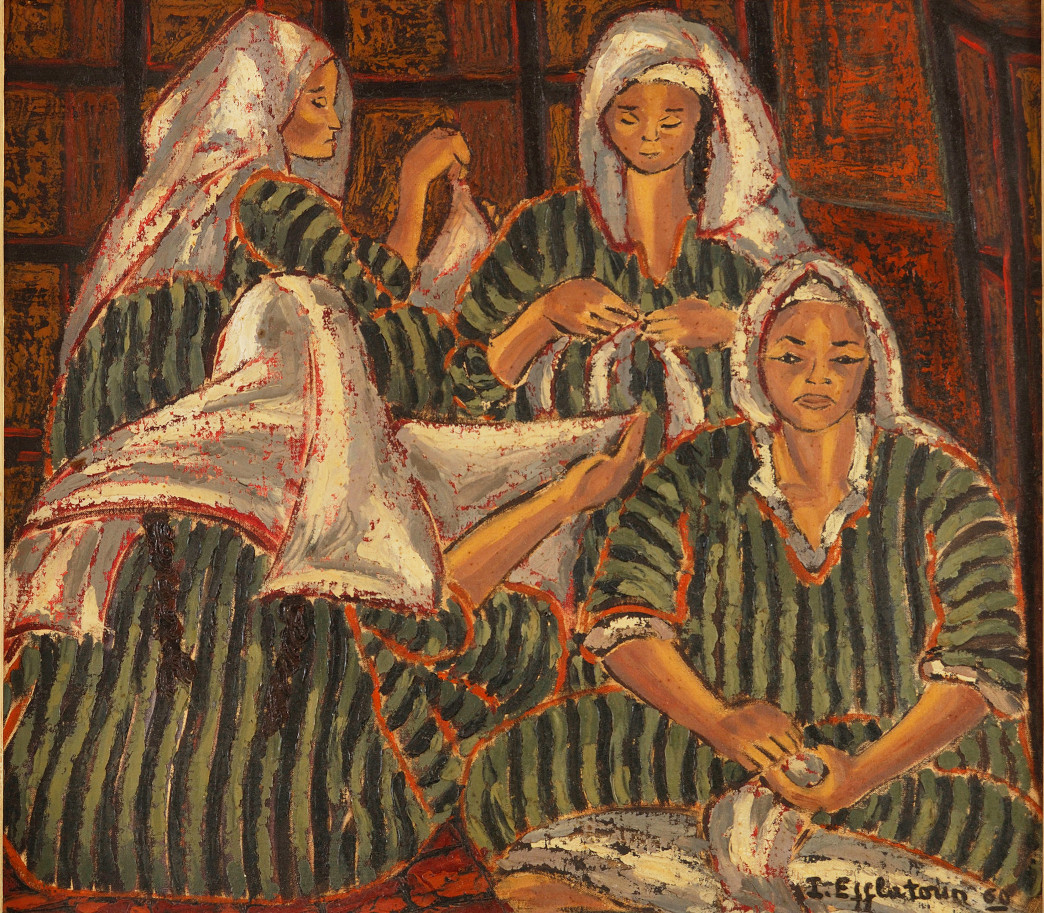
Inji Efflatoun (1924–1989)
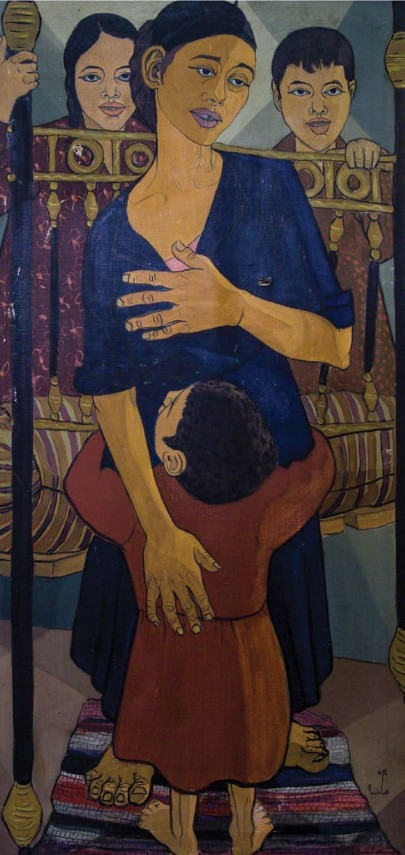
Efflatoun’s life and art embodied the moral message to humanity which every artist seeks to convey. Her spirit—always visible—was full of vitality and breathed life into those around her with simplicity, love, interaction and serious work even when imprisonment was the price she had to pay. Her life itself with all its details was in fact her greatest work of art. Efflatoun was an integral part of the Egyptian art scene from the 1940s—the era of the Art and Liberty Group—till her death in the 1980s. During that time, she populated the Egyptian landscape with works borne from the depths of Egyptians’ sorrows, traditions and characteristics; from workers and labourers to peasants and women from the vast Egyptian countryside. Her paintings were drawn with a lightness of spirit, drawing the eyes to feast on colours, shades and spaces pulsing with life and love. The eye roams over the surface of the canvas and meets the spirit of the artist—fragile and rebellious all in one.
Gazbia Sirry (b. 1925)
Gazbia Sirry made her mark on the Egyptian art scene in the 1950s and has continued to be active for more than half a century. She started out as a realist painter with socialist tendencies who derived her content from topics that, once tackled by an artist, open a floodgate of expression: the brush flies over the canvas like a tank moving over bodies and faces, over colours and lines, moving ever forward to infinity. Sirry’s journey is one of increasing minimalism: first, she minimized the fabric designs when she drew her characters’ clothing, then she minimized the number of characters on her canvas. Finally, she minimized the existence of the characters themselves, as if she had tired of them after a long, crowded train journey, drawing everything she had seen on the way until finally reaching her minimalist destination which is somehow still reminiscent of her earliest work: a family, a mother, a worker, a peasant woman, childhood, etc.
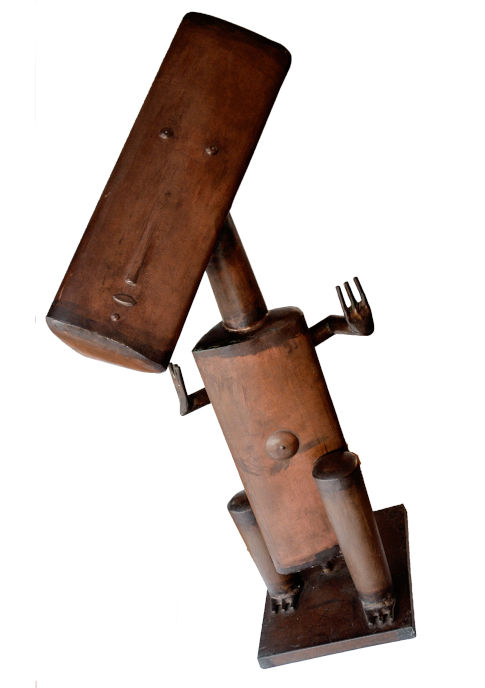
Sobhy Guirguis (1929–2013)
The simplification of form in the sculptures of Sobhy Guirguis is the basis of their beauty but it is difficult to categorize them as belonging to a particular school such as reductionism for example. Even though all his work takes the human form as its subject, and symbolically reduces it to the most elementary, even primitive shape, the creative, expressive energy finds its way to the surface through his vision and artistic arrangement of these shapes. Other artists who take the human form as a basis for their work are often entrapped by exaggeration and excess. Guirguis, on the other hand, adopts a simplicity of composition that defines and reproduces life. His carvings bring together times that have passed, grazing the skin as they went—both connected and unconnected—back to the soil from which they were born. The works of Sobhy Guirguis call upon the icons of Coptic art, which is deeply etched into the spirit of Egypt. His success lies in his capacity to reveal the bygone eras that brought forth his soul to this land, and to fold them into his metal creations.
Said al-Adawy (1938–1973)
Even though Said al-Adawy died young, he left behind a wealth of achievements to speak for his brief but shining passage through life. Visions of the end of the world are woven through the fabric of al-Adawy’s works, where the elements and realities are transformed and mutated to magical forms, sprayed across the space, as if they are armies of legendary ants, swarming through mazes of tombs and shrines. There are enlarged animals, monstrosities, and human shadows, traveling on the vessels of existence towards the unknown, through deserts and seas, mornings and nights, alien to any place or time: an entire world of the unknown.
Abdel Badie Abdel Hay (1916–2004)
Abdel Hay is a living example of the strength of artistic instinct that cannot be wiped away or effaced by the torrential onslaught of reality. The talented hand of this instinctive sculptor found the nurturing it needed to produce works of authentic folk art, pounding on the stone to transform its silence and lifelessness into an animated, pulsing creation. Through his approach to form and reduction, people, birds and animals around him are transformed to retain their living pulse in the heart of the stone.
Mohamed Taha Hussein (b. 1929)
Hussein moves seamlessly from one art form to another, using various techniques and artistic media—carving, drawing on ceramics, photography—and showing intelligence and vision in his experimentation throughout. After a long journey, the spirit of his heritage and the reverberations of its calligraphy came to rest in a visual equation that digested the influences of the West and coloured them with an Eastern spirit and Sufi essence in vast, dizzying compositions.

Youssef Limoud
Youssef Limoud is an artist and writer who works and lives between Basel and Cairo and writes on art for a number of Arabic periodicals and newspapers. He has recently published his research on Egyptian art in the sixties and seventies, as well as on the artist Ramsès Younan. He recently won the Grand Prix of the 2016 Dakar Biennale.